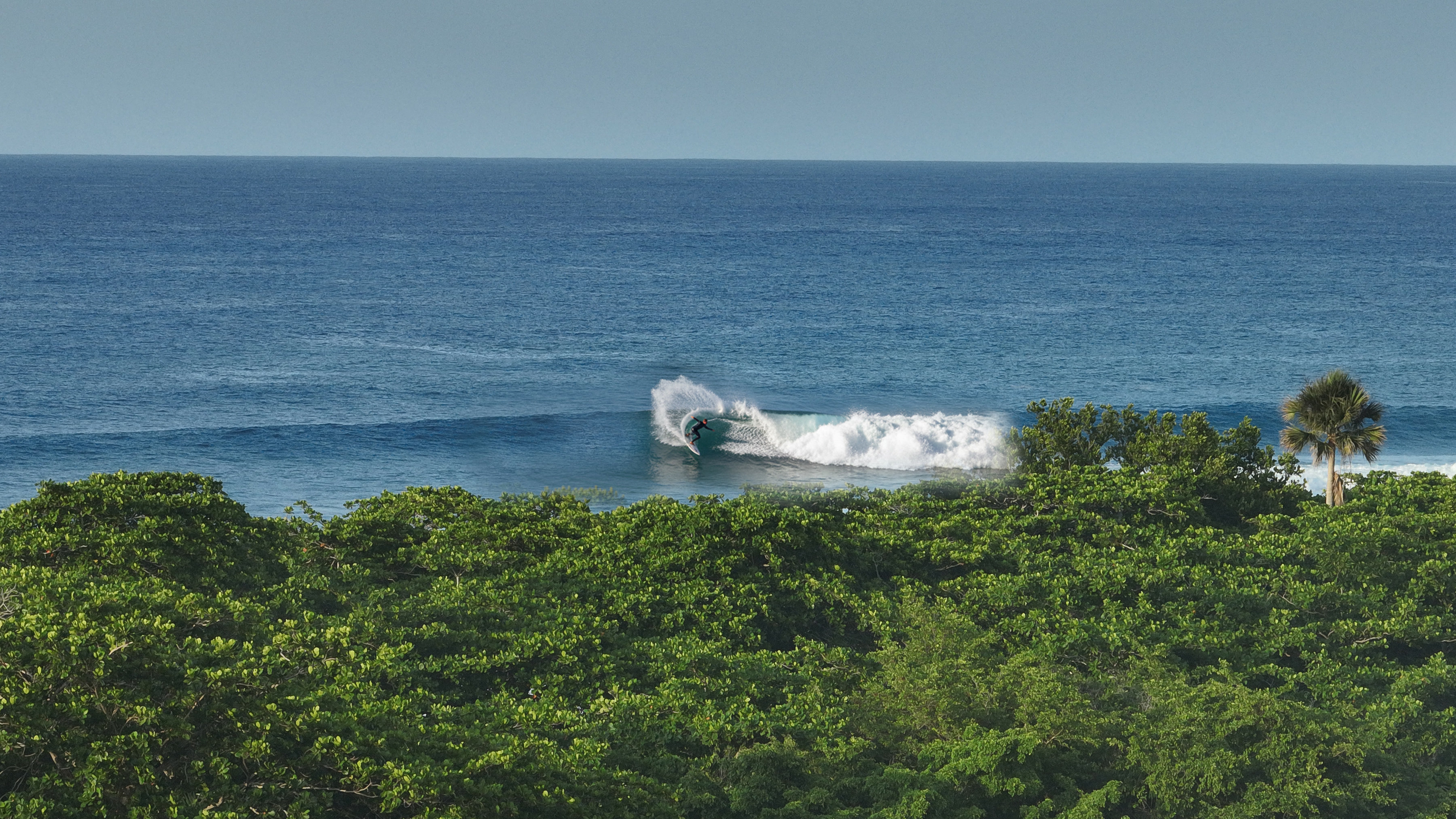
The north coast of the Dominican Republic faces open Atlantic. There is nothing between this shoreline and the storms that form thousands of miles away, and the reefs here are arranged to catch what those storms send. That is the whole explanation for why a stretch of coast most people have never heard of has surf all year.
This page is what we would tell a friend who asked before booking a flight: when it works, how the days run, what to bring, and what not to do.
01 · The year, month by month
There is a season here, and it is long. September through April is when this coast does what it is known for — north and north-east swell out of the Atlantic, arriving with enough period to stand up properly on the reefs.
- September – November — the sleeper months. Tropical systems are still turning out in the Atlantic and send long-period swell ahead of them, often with warm still mornings on this side. Consistently the best-quality window of the year
- December – March — peak winter. North Atlantic lows take over from tropical systems and the swell becomes more reliable, if colder in the air. Dawn sessions in January can want a 1 mm top; that is the extent of it
- April — the season signs off. Still plenty of swell, fewer people, warming up
- May – August — smaller and gentler. This is beginner and longboard season on the north coast; the south of the island picks up its own swell in these months instead
Which means the quiet answer to “when should I come” is October or November: the water is at its warmest, the swell is already running, and the winter crowd has not arrived.
02 · How a day runs here
The days follow the same shape almost year-round, and it is worth understanding because it decides everything.
- Dawn to mid-morning — light or no wind, often glassy, offshore. This is the session. It is also why everyone here goes to bed early
- Midday onward — the easterly trades fill in. Surf turns bumpy; the kiters and windsurfers take over toward Cabarete. This is when you eat, work or sleep
- Late afternoon — the wind eases again as the land cools. A second, softer window opens, often with the best light of the day
Two sessions, a long gap in the middle. Every routine on this coast is built around it.
03 · The water, and what to wear
The sea sits between roughly 26 and 29 °C all year. Nobody owns a wetsuit. In the coldest dawn of January, with air around 21 °C, some people put on a 1 mm top — mostly for the wind on the paddle back, not the water.
What you will actually want: reef booties. Several of the breaks here have coral or urchin-covered rock in the entry, and a torn foot ends a trip faster than a broken board. Rash guard and zinc for the sun, which is much stronger than the air temperature suggests.
04 · What kind of waves
Mostly reef, with some sand. That is the honest headline. The reefs give this coast its quality — waves that hold shape, break in the same place every time and can get hollow when the swell has direction — and they also mean this is not a forgiving coast to learn to duck-dive on.
The range across a short stretch is unusually wide: soft whitewater on the inside, mellow peaks that longboard beautifully, and outer reefs that turn serious when a real swell arrives. You can put a beginner and an experienced surfer in the water within a few hundred metres of each other and both be happy.
From the land
The breaks in front of the ATABAY lots are a five to ten minute walk. The wave at the channel is called El Canal — an easy paddle out and, most mornings, nobody on it. The others we leave unnamed on purpose.
Playa Encuentro — the most consistent spot on this coast, with several peaks for every level and a surf school on the sand — is 20 minutes on foot along the water, or seven by car.
05 · What to bring
- Winter (Sep–Apr) — your normal shortboard plus something with a bit more length for the bigger days. If you only bring one, bring the one you trust in overhead surf
- Summer (May–Aug) — a longboard or mid-length will get you far more waves than a shortboard will
- Spare fins and a leash — replacements exist here but not always in your size on the day you need them
- Reef booties, as above
- Board bag that survives baggage handling. Boards can be rented in Cabarete if you would rather not fight the airline
06 · The unwritten part
This coast is friendly by Caribbean standards, and it stays that way because people behave. The short version:
- The locals surf here every day of their lives. Wait your turn, and you will be treated well. Paddle around the peak and you will not be
- Learn at Encuentro, not on a reef with three people on it. There is a proper beginner zone and instructors who know it
- Spanish goes a long way, even badly. A buen día in the lineup changes the whole session
- Don’t geotag the quiet spots. This is not precious, it is the deal. The reason there is still an empty peak here in 2026 is that people who found it kept it to themselves
Conditions change and every swell is different; nothing here is a forecast. Check the surf report on the day, ask someone who paddled out that morning, and respect the people who surf this coast for a living.