Anyone can buy land in the Dominican Republic. Not anyone with residency, not anyone willing to set up a local company — anyone. A foreign buyer ends up holding exactly the same registered title a Dominican buyer holds, backed by the same state register. That is rarer than it sounds.
Most of the coastline people daydream about is fenced off in some quiet way. In Mexico, land within 50 km of the sea can’t be held directly by a foreigner at all — it goes into a renewable bank trust. In Thailand, Indonesia and the Philippines, foreigners simply cannot own land; what gets sold are leases and nominee arrangements that depend on someone else’s good behaviour. Several Caribbean islands make you apply for a licence first. In Costa Rica, the strip nearest the water is a concession, not property.
Here, none of that applies. No permit, no trust, no local partner holding your land on paper. You buy in your own name and the national registry lists you as the owner.
Which means the question isn’t whether you may buy. It’s whether the particular piece of land in front of you is what the seller says it is — and that question is answered entirely on paper. This page is about how to read that paper.
01 · The paper that decides everything
In a lot of countries, proving you own something means tracing a chain of old contracts backwards and hoping nobody in that chain lied. The Dominican Republic works differently. It uses what’s called a Torrens system: the state itself keeps one register of who owns what, and that register is the answer. Not the seller’s word. Not a private agreement. The register.
The document that comes out of it is the Certificado de Título. Think of it less as a receipt and more as the state’s own written statement: this parcel, this size, this owner, these charges against it. It carries a matrícula number, and that number is the thread you can pull on.
Here is the part that should relax you: you can check it yourself, at ji.gov.do, the portal of the Jurisdicción Inmobiliaria. Not through the seller, not through an agent, not through anyone with something to gain. If a property is real and clean, an afternoon and an internet connection will tell you so.
02 · The document nobody thinks to ask for
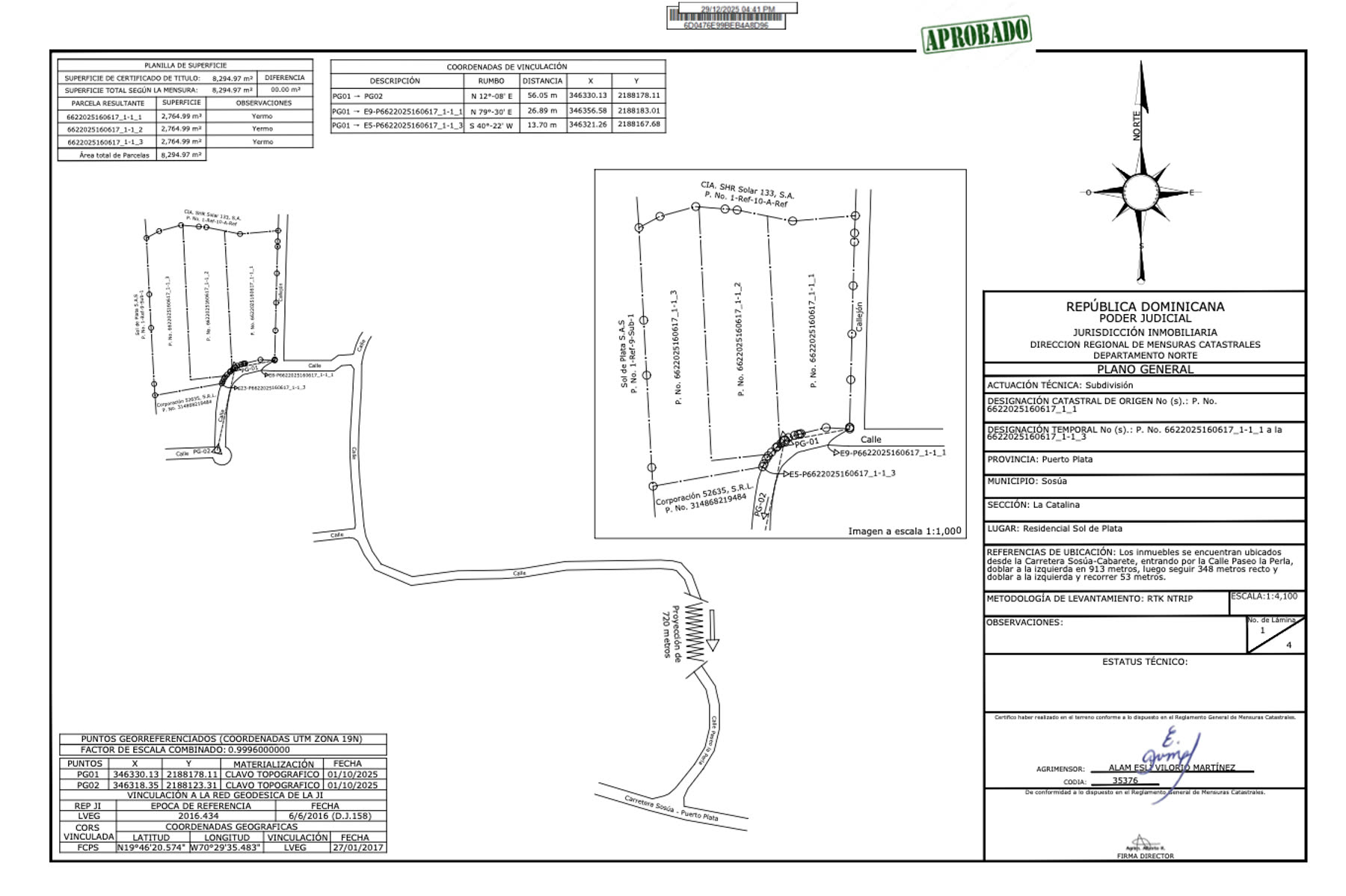
A title tells you that you own a parcel. It doesn’t, on its own, tell you exactly where that parcel begins and ends. That’s the job of the deslinde — the approved survey, signed off by the regional office of Mensuras Catastrales and filed into the national cadastre.
Land with a title but no approved survey is land whose boundaries are still, technically, an opinion. And opinions have neighbours. Most of the ugly stories foreign buyers tell about this region start exactly there: a beautiful piece of coast, a real title, and a boundary that turned out to be negotiable.
So the two documents belong together. Title without survey is half an answer.
03 · The file you should be handed
Before any money moves, ask for the following. A seller who has them will send them the same day. A seller who hesitates has just told you something important, for free.
- The Certificado de Título, in the seller’s name, current, matrícula visible — proves the seller is actually the owner, not a relative, a partner or a company that dissolved
- The approved survey, with a cadastral number matching the title — proves the land on the map is the land under your feet
- Certificación de estado jurídico — the registry’s own statement of mortgages, liens and disputes. This is what catches the problems a title alone hides
- Proof the property tax is paid — unpaid IPI stays with the land, not the seller. You would inherit it
- The community rules and fees, if it’s a gated development — these bind you as firmly as the law does, and they decide what you may build
- Corporate authority, if the seller is a company — the assembly minutes authorising the sale and naming who may sign it
04 · How a purchase actually goes
You hire your own attorney first. Not the seller’s, however friendly the offer. This single decision does more to protect you than everything else on this page combined — a Dominican real estate attorney working for you can pull registry records directly and read them properly.
Then the shape of it: your attorney runs due diligence and confirms the title, the survey and the absence of charges. You sign a promise of sale that fixes price, terms and deadlines, usually against a deposit. When the conditions are met, you sign the acto de venta, the deed itself.
Both of those signatures happen in front of a Dominican notary — that isn’t a formality you can email your way around. If you can’t be in the country, a power of attorney is completely normal here; it can be executed at a Dominican consulate or apostilled from home.
Who people here actually use
Finding an attorney from the other side of an ocean is the hardest part of this for most buyers. These are the names that come up repeatedly on this coast, from people who have bought and sold here for years:
- Guzmán Ariza — one of the largest real estate firms in the country, with an office in Sosúa. They also publish a genuinely useful public guide to the purchase process, worth reading alongside this one
- Guido Perdomo — Sosúa
- Joel Carlo — Sosúa
We have no arrangement with any of them and earn nothing if you call. That is rather the point: the person checking the documents should have no interest in the sale going through.
After signing, the transfer tax gets paid to the tax authority (DGII) — the registry will not move until it is. Then the deed is filed and a fresh Certificado de Título is issued in your name. That last step typically takes anywhere from a few weeks to a few months, depending on which registry office is handling it. Your ownership dates from the filing; the certificate is the paper that catches up.
05 · The money beyond the price
Set aside a budget on top of the purchase price. The three that matter:
- Transfer tax — 3 %. Calculated not on what you pay, but on the fiscal value the DGII assigns the property. The two numbers are often different, so ask your attorney to estimate it early rather than be surprised at the end
- Your attorney. Some firms charge a percentage — customarily around 1 to 1.5 % — others a flat fee for a straightforward purchase. Rates move, and they differ from firm to firm, so the only number worth having is the one you get in writing: ask two of the firms below for a quote before you engage anyone. It takes an email and it is the best money in the whole transaction either way
- Notary and registry fees — modest, but real
And then the one that catches people out
The annual property tax here is called IPI, and it runs at 1 % of the government-appraised value per year. For a built property, it only kicks in above an exemption threshold — currently around DOP 7,019,383, roughly US$ 150,000, adjusted every year for inflation. Plenty of homes fall under it entirely.
Vacant land gets no such exemption. The full 1 % applies from the first peso of appraised value. It surprises almost everyone, because the instinct is that an empty lot must be cheaper to hold than a house. Here it can be the other way round. The bill falls due by 11 March, or in two halves on 11 March and 11 September.
None of this is a reason not to buy — it is a reason to put the number in your spreadsheet before you fall in love with a view. Rates, thresholds and appraisals shift; have your attorney confirm today’s figures rather than trusting any page on the internet, including this one.
06 · How it goes wrong
Nearly every bad story in this region is a variation of one of these five.
- “There’s no title, but the rights of possession are solid.” — Derechos de posesión are not ownership. They are a claim, and claims can be contested by people you have never met. This is where the worst outcomes begin
- A title, but no approved survey. — You are buying an area, not a place. The edges are still open to argument
- “Use our attorney, it’s simpler and cheaper.” — It is simpler and cheaper. It is also the seller’s attorney
- Pressure to pay before due diligence finishes. — There is no legitimate transaction that requires this. Urgency is a sales technique, not a legal condition
- The surface area on the contract doesn’t match the survey. — A small discrepancy is never small. It means at least one document is wrong, and you don’t yet know which
07 · After it’s yours
It stays in the family
There are no restrictions on foreigners inheriting Dominican property. Better still, since a 2014 conflict-of-laws statute, a foreign owner can have the inheritance rules of their own home country applied to their Dominican property instead of the local forced-heirship rules. If you are buying something you intend to pass on, that is a quietly enormous advantage — and one most tropical jurisdictions do not offer.
When you build
Construction needs environmental approval from the Ministry of Environment under Law 64-00. How involved that is scales with what you are building: a single family house on a titled residential lot inside an existing community is the gentle end of it — but it is a step with a timeline, not a rubber stamp, so plan for it.
If the land sits in a gated community, the house rules will shape your architecture as much as any law: permitted height, setbacks, materials, and plan approval before anyone breaks ground. Read them before you buy, not after you have paid an architect.
08 · How this land measures up
Everything above is also, honestly, the reason this particular property exists in the shape it does: three separate, individually titled and surveyed parcels rather than one loosely described stretch of coast.
On the record
Each of the three lots holds its own registered Certificado de Título, issued by the Registro de Títulos of Puerto Plata in January 2026, each with its own matrícula number.
The subdivision was approved by Mensuras Catastrales in December 2025 — surveyed, filed and registered, each lot at 2,764.99 m². Title and survey, together, as they should be.
It sits inside Sol de Plata, an established gated community, so the rules, the monthly fee and the building restrictions are all written down and in the file — nothing about your holding costs or what you may build has to be guessed at.
And all of it is verifiable at ji.gov.do before you ever pick up the phone. The full package — titles, approved plans, subdivision resolution and community rules — is available on request.
This page is orientation, not legal advice. Property law and tax figures in the Dominican Republic change, and every transaction carries its own facts. Engage your own Dominican attorney and have them verify every document and number before you commit to anything — including everything written here.